
Europe is arguing about how much the recovery will cost. A new World Bank and NBER study suggests the harder question is who will be allowed to carry it out.
In 2005, a newly founded Ukrainian company behaved roughly like a newly founded American one. It either grew fast or it disappeared. By 2019, the same company behaved like one in India: it survived, it stayed small, and it never became anything.
The war did not do that. The decline began in 2008 and deepened after 2014, long before the first missile fell on a substation. That is the uncomfortable finding of “Engineering Ukraine’s Wirtschaftswunder”, a working paper published by the National Bureau of Economic Research in August 2025 by Ufuk Akcigit, Furkan Kilic, Somik Lall and Solomiya Shpak, written with the World Bank and the Kyiv School of Economics.
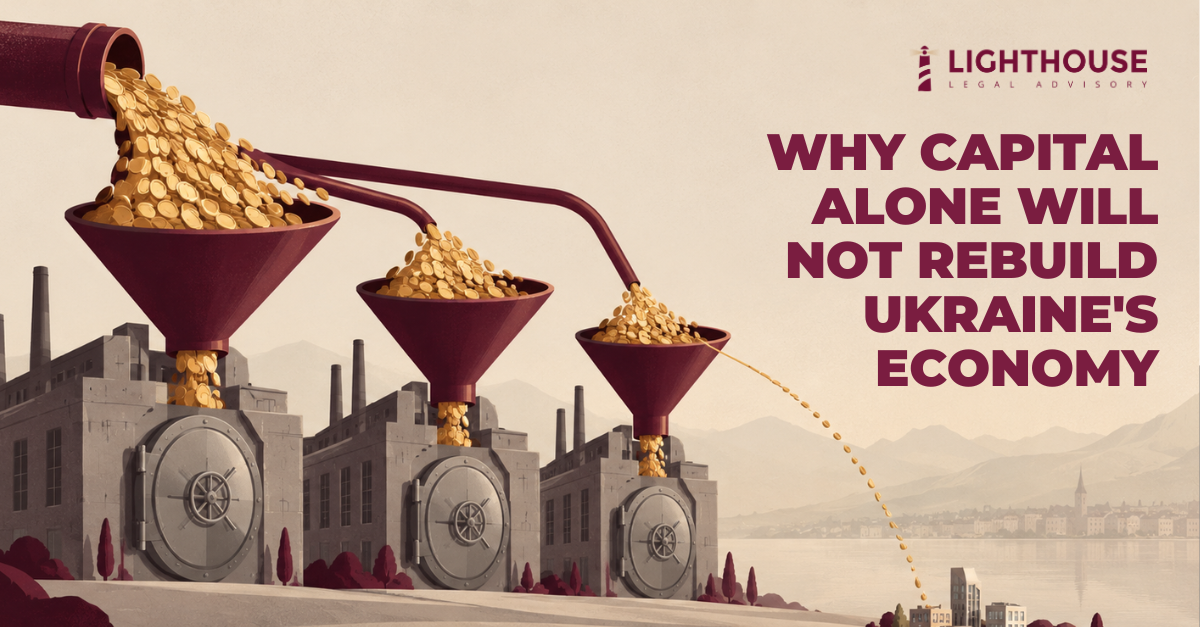
The authors used registration and balance sheet records covering almost every enterprise in the country across 25 years. It is the most complete picture of Ukrainian business dynamics anyone has produced. And its conclusion is one that a reconstruction conference is unlikely to put on the main stage: money entering a captured market does not create growth. It creates stronger incumbents.
The decline started in 2008
Between 2002 and 2007, Ukrainian firms showed what economists call “up or out” behaviour. New companies scaled quickly or exited, freeing up workers and market share for the next attempt. It is the ordinary metabolism of a functioning economy, and Ukraine had it.
Between 2008 and 2013 that metabolism slowed to something resembling Mexico. After 2014 it stalled altogether. Young firms barely grew over a decade.
Ten separate indicators move in the same direction: entry rates, firm growth, exit, the link between productivity and size, the responsiveness of jobs to efficiency gains. When every measure points the same way, it is structure, not noise.
Big, and not good at it
By 2019 the four largest companies in four-digit manufacturing sectors held close to 53% of sales, up from 48 to 49% in the early 2000s. The comparable figure in the United States, one of the most concentrated economies in the world, is around 44%.
Concentration alone is not a problem, and the authors say so plainly. Large firms are often large because they are good. In Ukraine, concentration arrived alongside falling productivity and collapsing entry, which points to a different story. Total factor productivity growth in manufacturing averaged 15.2% between 2002 and 2013, then fell to 3.7% between 2014 and 2019. The market leaders were not using their position to produce more. They were using it to keep the position.
The state as a competitor
State-owned enterprises sit disproportionately among the least productive firms in the economy, holding roughly 13% of sales in the two lowest productivity quintiles of manufacturing. Their share of the most productive quintile fell from 2% to 1%.
And yet their overall market share has grown.
This is what makes privatisation a legal design question rather than an ideological one. A badly structured sale moves an asset from a slow public owner to a protected private one and changes nothing about whether the market is open.
Foreign money that never left
A large share of what Ukraine records as foreign direct investment is domestic capital that was routed through offshore centres and brought back home. It arrives with the legal and financial standing of foreign ownership, but without new capital or technology.
The outcomes diverge sharply. Genuine foreign investment raises employment in recipient firms by up to 30%, labour productivity by 19% and total factor productivity by 12%. Tax-haven investment raises employment by 18% and labour productivity by 11%, with no significant gain in total factor productivity at all.
The effect on the wider market is the striking part. Industries that receive tax-haven FDI show 27% less new business entry, with average entry rates of 6.9% against 9.4% elsewhere. The capital is not neutral. It correlates with a market that is harder to enter.
For anyone running diligence on a Ukrainian counterparty, this moves beneficial ownership out of the compliance annex. Where the money above your counterparty actually comes from is not only a sanctions question. It tells you something about the competitive shape of the market you are entering.
Why the usual fixes fail
The authors then do something most diagnostic papers avoid. They build a model of creative destruction with institutional capture, calibrate it to Ukrainian data, and test the standard policy toolkit.
Subsidies for new entrants produce almost no long-run growth, at any level of entrenchment. They raise the cost of researchers and shorten the expected life of any profit a good firm earns, which discourages precisely the innovators who would have delivered growth.
Subsidies for incumbent research do work, but only where capture is low. As entrenchment rises, the same policy loses most of its effect, because productive firms expect to lose their product lines to insiders regardless of how good their technology is.
The conclusion is blunt. Targeting firm types is not enough. Disciplining entrenched incumbents is the condition that makes every other instrument work.
The two Germanies
The Wirtschaftswunder in the title is doing real work. West Germany’s recovery in the 1950s did not begin with capital. It began with dismantling wartime industrial cartels and building a competition regime, and the growth followed.
East Germany after 1990 is the counter-case. Privatisation was accelerated under political pressure ahead of the 1994 elections. Assets went in large part to West German firms, local entrepreneurship was crowded out, and the regional imbalances are still visible three decades later. The process delivered consolidation, not renewal.
Ukraine is heading into large-scale privatisation and a discussed capital amnesty under exactly the conditions that produced the second outcome: urgency, political pressure, and a small group of actors already positioned to benefit.
The Swiss question
Switzerland has committed CHF 5 billion to Ukraine for 2025 to 2036, including a CHF 500 million window for private sector projects administered by SECO. Swiss companies moving through that window will be negotiating inside the market structure this paper describes, whether or not anyone names it in the room.
Three questions move up the list as a result.
Who ultimately controls the counterparty, and whether the foreign shareholder above it is bringing capital into the country or simply re-entering it.
Whether the tender or privatisation is structured to be genuinely contestable, or structured so the outcome is known before it opens.
Whether the sector has already lost its entry rate, which changes both the valuation and the exit.
These are legal design questions long before they become investment questions. They are cheap to ask at term sheet stage and very expensive to ask later.
What is actually at stake
The paper closes on a wider point. Europe has its own dynamism problem, documented at length in the Draghi report. If Ukraine builds its recovery around competition and firm-level productivity rather than around transfers, it does not merely become a post-war success story. It becomes a source of dynamism for a continent that is running short of it.
The alternative is a rebuilt country with the same owners.
Source
Ufuk Akcigit, Furkan Kilic, Somik Lall and Solomiya Shpak, “Engineering Ukraine’s Wirtschaftswunder”, NBER Working Paper 34103, August 2025. nber.org/papers/w34103