
A little-known federal platform has turned CHF 20 million into more than 200 clean-technology projects across the Global South — and its model is exactly the kind of instrument Ukraine’s green reconstruction will need.
Executive summary
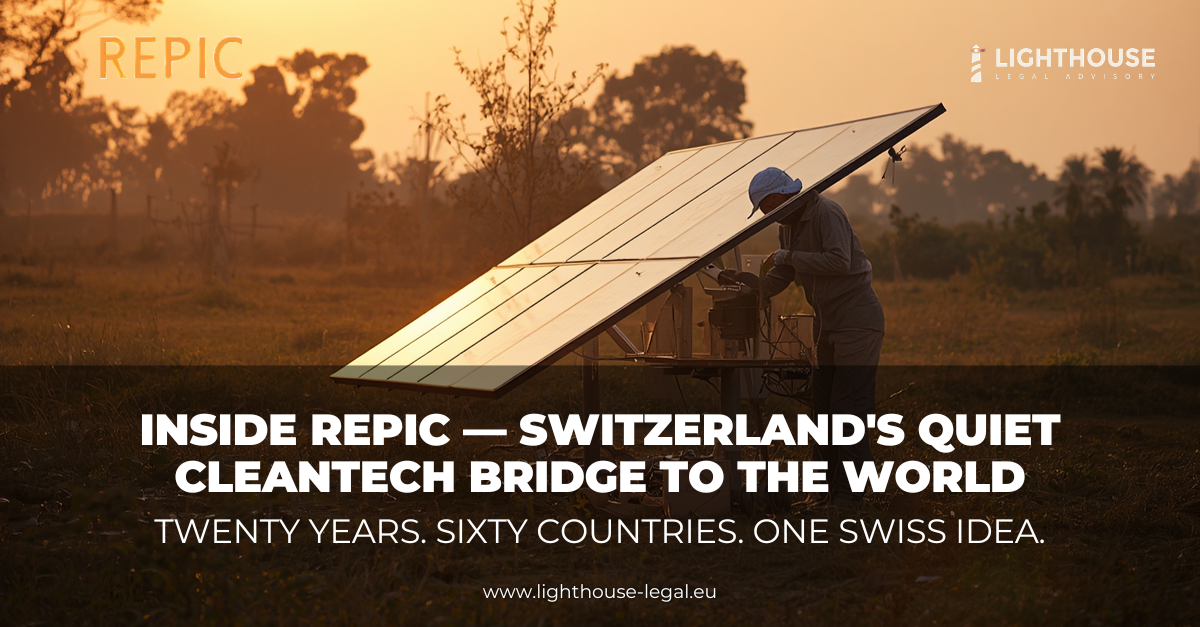
REPIC is one of the most effective Swiss instruments almost nobody outside the sector has heard of. Since 2004, this interdepartmental platform — jointly run by four federal offices — has co-financed over 200 renewable-energy and resource-efficiency projects in 60 developing and transition countries, reaching 2.3 million people while keeping its own contribution capped at half of each budget. For anyone building the Swiss–Ukrainian energy and reconstruction agenda, REPIC is worth understanding not as charity, but as a disciplined co-investment model that turns Swiss engineering into projects that actually get built.
A platform hiding in plain sight
Most public funding bodies announce themselves loudly. REPIC does the opposite. It has no marketing budget to speak of, no glossy campaign, and a name that reads like a compliance footnote: Renewable Energy, Energy and Resource Efficiency Promotion in Developing and Transition Countries.
Behind that mouthful sits one of the more elegant ideas in Swiss development policy. Founded in 2004, REPIC is an interdepartmental platform — a rare structure in which four federal offices pool mandate and money instead of competing for it:
- SECO — the State Secretariat for Economic Affairs
- SDC (DEZA) — the Swiss Agency for Development and Cooperation
- FOEN (BAFU) — the Federal Office for the Environment
- SFOE (BFE) — the Swiss Federal Office of Energy
Economic policy, development cooperation, environment and energy — four departments that elsewhere would guard their own budgets, here backing a single portfolio. The day-to-day is run lean, through a mandated secretariat (NET Nowak Energie & Technologie), which keeps REPIC closer to a venture desk than a ministry.
What REPIC actually funds
REPIC does one thing, and does it deliberately: it helps Swiss expertise move renewable energy, energy efficiency and resource efficiency into countries that need it. Solar and small-scale hydro, biomass and biogas, cold chains and cooling, recycling and the circular economy — and, since 2024, water projects too.
The mechanism matters more than the list. REPIC works through two instruments:
- Pilot — up to CHF 150,000 per project, to prove a concept works in real-world conditions.
- Rollout — introduced in 2022, up to CHF 500,000, to scale a proven model commercially.
And there is a rule that quietly does most of the work: REPIC never covers more than 50% of a project’s cost. Every franc it commits must be matched by a franc from someone with skin in the game. That single constraint filters out the tourism and forces co-investment, local partners and a credible path to sustainability before public money moves. Projects must be Swiss-led, address a genuine local need, and — crucially — show replication potential. REPIC is not buying one solar array; it is buying a template.
Eligibility is tied to the OECD DAC list of ODA recipients — the internationally agreed roster of developing and transition economies. Applications run through a disciplined two-stage process: a short project outline first, a full proposal only if it clears the bar, with fixed deadlines several times a year.
The numbers behind the model
Twenty years in, the portfolio speaks for itself:
- 200+ projects co-financed since 2004
- 60 countries across Sub-Saharan Africa, Latin America, Asia and Eastern Europe
- 2.3 million people reached
- 288,277 tonnes of CO₂ emissions avoided
- 22,240 MWh of annual clean energy generated — roughly the consumption of 20,000 urban households in Senegal
- 6,400+ people trained
- More than CHF 20 million committed through the Pilot instrument alone
The individual cases make the abstraction concrete. A biogas programme in Vietnam brought clean cooking energy to 491 families. Solar installations by CANDI in India avoided some 90,000 tonnes of CO₂. Swiss startup Openversumscaled a micro-franchise model for drinking-water filters in Colombia; Subasol built battery storage for solar in Cameroon and Ghana; Sustain Switzerland paired solar with aquaculture in Tanzania. None of these are megaprojects. All of them are replicable — which is the point.
Why the 50% rule is the real innovation
It is tempting to read REPIC as a grant-maker. It is closer to a de-risking engine. Clean technology in emerging markets fails not because the engineering is wrong but because the first commercial deployment is too risky for private capital and too small for a development bank. REPIC sits precisely in that gap: it absorbs enough of the early risk to make a pilot fundable, then steps back and lets the market carry a proven model forward through Rollout.
That is a different philosophy from writing cheques. It treats public money as leverage, not subsidy — and it is exactly the logic that serious reconstruction financing runs on.
Why this matters for Ukraine
Here is the part that should interest anyone watching Swiss–Ukrainian business. Ukraine is a transition country on the DAC list. Its energy system has been deliberately targeted and degraded; rebuilding it will not mean restoring the old centralised grid, but building a more distributed, resilient, lower-carbon one — solar, storage, efficiency, decentralised heat.
That is REPIC’s exact domain. The platform is built to move Swiss cleantech know-how into precisely this kind of environment, through a co-financing structure designed for places where risk is high and capital is cautious. A Swiss engineering firm, a Ukrainian municipality, a proven storage or efficiency technology, a 50/50 split that forces genuine partnership — the template already exists.
Ukraine’s green reconstruction will ultimately be won or lost on instruments like this: not on headline pledges, but on the unglamorous machinery that turns a good technology and a willing partner into a project that is actually built and actually lasts. REPIC has been refining that machinery for two decades.
Save the date: REPIC Annual Event 2026
REPIC’s flagship gathering returns on 26 November 2026 in Bern, and — as always — attendance is free. It is one of the few rooms where project developers, sustainability specialists and the federal network sit together: first-hand updates on portfolio projects, real case studies rather than slideware, and the kind of direct exchange that turns an idea into an application. For anyone thinking seriously about Swiss cleantech and its role in transition economies — Ukraine included — it is a conversation worth being in.
The takeaway
REPIC is a reminder that the most useful funding instruments are often the least visible. Twenty years, CHF 20 million, 60 countries, and a single discipline — never more than half — have produced a model that quietly works. As Europe turns to the question of how Ukraine rebuilds, that model deserves a much wider audience.
Lighthouse tracks the Swiss instruments, partners and legal structures shaping Ukraine’s reconstruction. If you are a Swiss cleantech company, a Ukrainian partner, or an investor exploring this space, we can help you map the route.
Understand why this matters → info@lighthouse-legal.eu
Source: repic.ch