
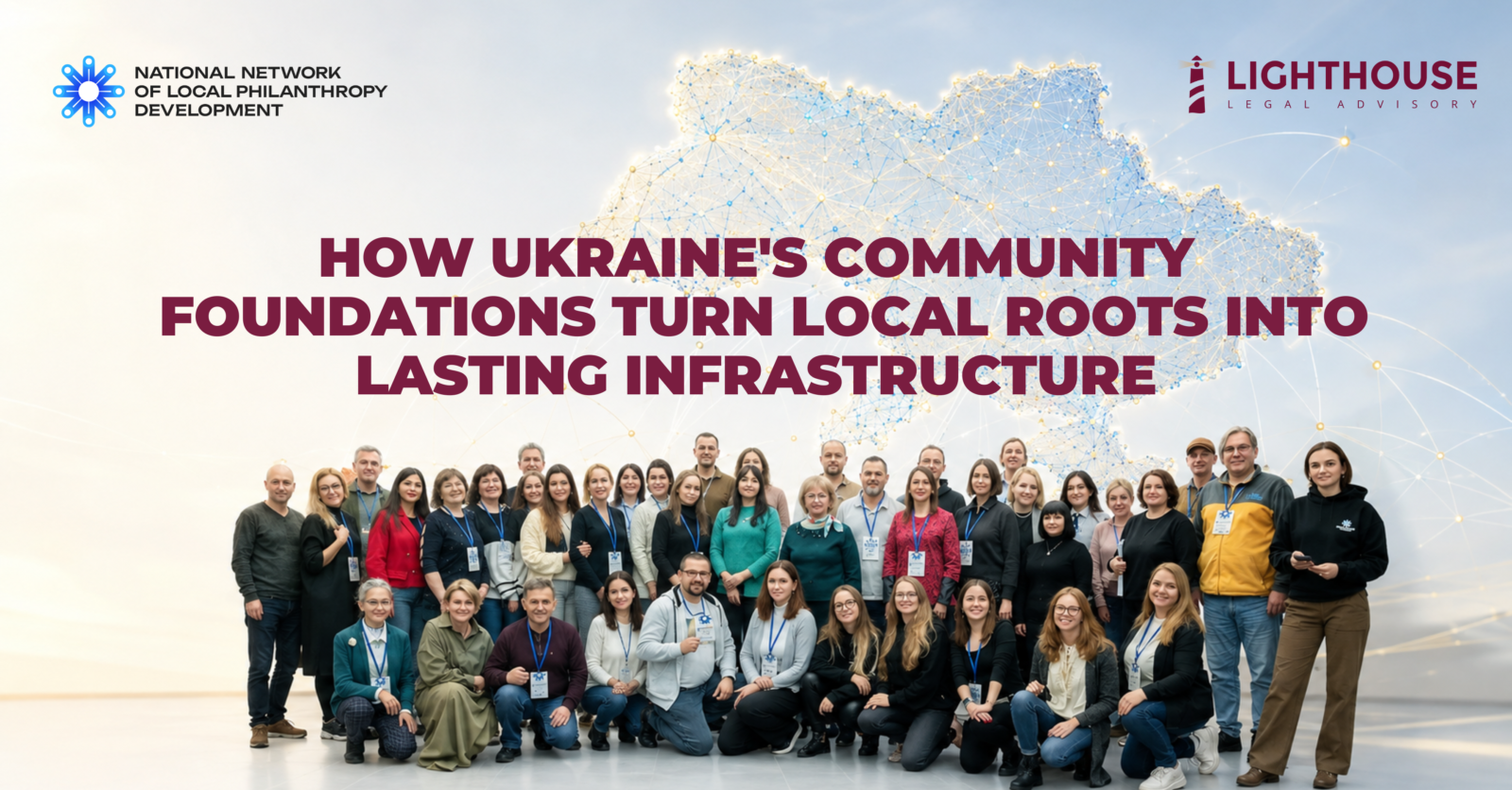
As international donors wind down their presence in Ukraine, a network of 22 community foundations is emerging as the most direct — and most accountable — channel for the capital that remains
By Viktoriia Zablotska — Program Manager, National Network of Local Philanthropy Development
Executive summary. In the fifth year of the full-scale invasion, international NGOs and donor structures are steadily leaving Ukraine — partly because emergencies elsewhere are competing for finite resources, and partly because five-year funding cycles are running out. The question this raises is not how to replace that money, but how to spend what is still available in a way that builds a system capable of standing on its own. Ukraine’s community foundations — locally rooted, permanently present, and already trusted in their towns — offer exactly that. For Swiss businesses and donors looking for a reliable entry point into Ukraine’s recovery, a network of 22 such foundations across 13 regions is a ready-made channel that reaches the community level directly, without building anything from scratch.
The countdown facing Ukraine’s donors
In the fifth year of the full-scale invasion, a growing number of international non-governmental organisations and other donor structures are ending their operations in Ukraine. The reasons are structural rather than political: new emergencies keep erupting around the world and the resources to address them are finite, and much of the money committed to Ukraine was allocated on roughly five-year horizons that are now approaching their end.
That leaves a sharper question than the one most recovery conversations ask. Not how do we bring in more money — but how do we use the resources still available to Ukraine to create the greatest impact, and to build a self-reliant system that will not collapse once more donors leave?
For the National Network of Local Philanthropy Development, the answer is unambiguous: build genuine, equal partnerships with local actors — community foundations above all — and in doing so strengthen the organisations that will remain on the ground and keep working long after the large international players have gone.
What a community foundation actually is
A community foundation is an organisational model built to improve quality of life in a specific place or community. These foundations identify local needs, encourage charitable giving, and pool the funds they raise to award grants or run initiatives that address the community’s most pressing problems.
In practice, a community foundation plays three roles at once:
● A local grantmaker — deciding which initiatives to fund in its own territory.
● An instrument of philanthropy — a trusted vehicle through which residents and businesses give.
● A community leader — convening people and setting priorities on the ground.
The examples are concrete. The Boyarka Community Foundation regularly accumulates funds from local donors and uses them to run open competitions supporting local initiatives. The Community Foundation “Podilska Hromada” works closely with local entrepreneurs to create corporate funds that support the surrounding population — awarding scholarships to talented children, for instance, or backing craft producers.
The effect of this work is long-term. Community foundations build trust and cooperation, strengthen a community’s sense of self-determination and capability, and advance social cohesion — outcomes that outlast any single grant.
The role of the National Network of Local Philanthropy Development (NNLPD)
The National Network of Local Philanthropy Development is a membership organisation uniting Ukraine’s community foundations to develop local philanthropy and volunteering, activate residents, and support civic initiatives. As of August 2026, the NNLPD brings together 22 community foundations across 13 regions of Ukraine.
The NNLPD represents the collective voice of Ukrainian community foundations at both national and international level, and strengthens its members across five directions: communications, funding, organisational capacity, advocacy, and building an enabling environment for local philanthropy. It also runs network-wide projects that draw its members in — among them “Harwest Way”, delivered in partnership with Germany’s Robert Bosch Stiftung, and “YouthBanks of Initiatives” in cooperation wuth Foundation de France and RAZOM for Ukraine.
For donors and international NGOs, the NNLPD solves a practical problem: it simplifies the work of engaging with local organisations. A single partnership with the NNLPD opens access to 22 vetted local foundations at once — without the additional due-diligence and verification processes each separate engagement would normally require.
Why local foundations hold a trust others can’t buy
Community foundations are structures that have worked in their communities for years, and their locality is their advantage. They hold detailed knowledge of the needs and resources in a community, understand who should be involved in which projects, and know what is already under way — so effort is not duplicated.
But the deepest source of their credibility is simply who works inside them. A community foundation’s team is not made up of external consultants or representatives flying in on short missions. It is made up of people who live in the town or village themselves, who are raising their children there, and who have a personal stake in seeing their community improve. They are not abstract project implementers — they are part of the very community they help.
That on-the-ground presence has direct practical value. A foundation’s team can see, effectively every day, how a given project is actually going: whether the greenhouse was really built, whether the equipment bought with grant money is working, whether the initiative they backed is producing a real effect. That level of monitoring is simply impossible for a donor or an organisation operating remotely from another city or country.
And because these are people who have worked in their communities for years — not for the length of a single project cycle — they have had time to build personal relationships with local business, local government, activists and ordinary residents. That is why people turn to a community foundation not as just another charity, but as people they know personally and have trusted for years.
Ready infrastructure for those looking for whom to support
Which brings us back to the question this article began with: what should be done with the resources still available to Ukraine at the moment international donors are gradually scaling back? The answer the community-foundation model proposes is not to build infrastructure from scratch, but to strengthen what already exists and has a proven track record.
A network of 22 community foundations across 13 regions is a ready channel for directing resources straight to the community level — not only through state structures or large international organisations. For Swiss businesses and donors seeking reliable entry points into the reconstruction process, that means several concrete formats of cooperation:
● Targeted funding of a network-wide project — such as “Harwest Way,” delivered in partnership with the Robert Bosch Stiftung.
● Direct partnership with an individual community foundation in a specific region.
● Support for network programmes that strengthen the capacity of all members at once.
It is worth distinguishing two very different types of contribution a Swiss business or donor can make.
The first is funding a specific project: build a greenhouse, buy a generator, support a single initiative. Such projects are needed and deliver results here and now — but once the grant cycle ends, the foundation is back to searching for its next source of funding.
The second is investing in the foundation’s own capacity to remain self-reliant, regardless of whether the next grant arrives. This can mean supporting an endowment that generates steady income for the foundation’s work, or helping to create a social business whose profit funds local initiatives. In this approach, the foundation stops being merely an implementer of other people’s projects and becomes a durable economic actor in its own community — able to make decisions and finance them independently, even when external funding shrinks or disappears.
What this means for Swiss partners
For Swiss businesses, family offices and donors, the strategic point is the long-term character of this kind of support. Unlike one-off humanitarian aid, backing community foundations is an investment in institutions that will remain in the community after specific aid programmes end and after one more international donor departs.
The practical takeaways are straightforward:
● The channel already exists. Twenty-two vetted foundations in 13 regions can be reached through a single point of contact, without standing up new infrastructure or running 22 separate due-diligence processes.
● Monitoring is built in. Local teams verify results on the ground daily — accountability that remote funding structures cannot match.
● You can choose your horizon. Fund a concrete project for immediate impact, or invest in endowment and social-business capacity for lasting self-reliance.
It is this resilient, local-driven infrastructure that will allow Ukraine to keep rebuilding even as external support narrows.
Interested in partnering with Ukraine’s community foundations, or funding a project or endowment through the NNLPD? Get in touch with the author, Viktoriia Zablotska, Program Manager at the National Network of Local Philanthropy Development — or write to Lighthouse at info@lighthouse-legal.eu and we’ll make the introduction.
See why local trust may be the most reliable infrastructure Ukraine’s recovery has.