From frozen Russian assets to Danish investment interest: why Ukraine is moving from beneficiary of European support to partner in Europe’s security and economic architecture.
By Anastasiia Dziuba, Steering Committee, Lighthouse Legal Advisory
Executive summary
On 7 October 2026, the International Bar Association’s Annual Conference in Copenhagen hosted a conversation on Ukraine with two Ukrainian ambassadors and Denmark’s Ambassador to Ukraine. The discussion treated Ukraine not only as a matter of war and security, but as a test of international law, European resilience, accountability and long-term economic partnership. Three shifts stood out: the debate on frozen Russian assets is moving from aid to reparations; accountability is increasingly framed as deterrence; and European business is starting to look beyond aid towards structured investment.
On 7 October, the International Bar Association hosted “A conversation on Ukraine with… Andriy Kostin, Anton Korynevych and Thomas Lund-Sørensen”, moderated by Dr Mark Ellis, Executive Director of the International Bar Association. The session brought Ukrainian and Danish perspectives to the approaching winter, European support, frozen Russian assets, reparations, the Special Tribunal for the Crime of Aggression, diplomatic prospects and Ukraine’s future place in Europe.
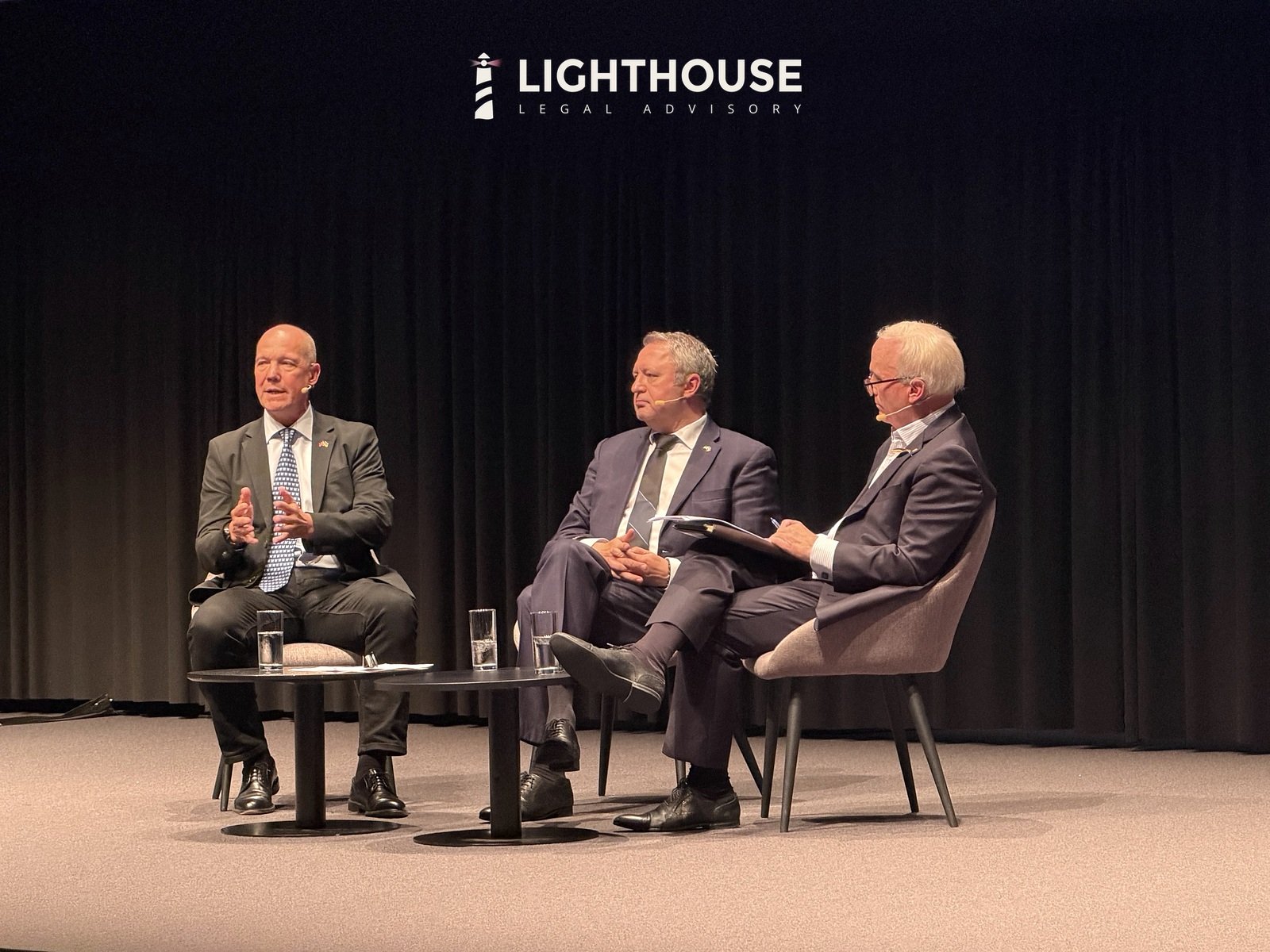
Thomas Lund-Sørensen, Ambassador Andriy Kostin and Dr Mark Ellis on stage at the IBA Annual Conference Copenhagen 2026, 7 October 2026.
The speakers brought particularly relevant perspectives.
Ambassador Anton Korynevych, Ambassador-at-Large at Ukraine’s Ministry of Foreign Affairs, is Ukraine’s Agent before the International Court of Justice in major cases against the Russian Federation and is directly involved in work on frozen Russian assets, compensation mechanisms and the establishment of a Special Tribunal for the Crime of Aggression. He joined the conversation remotely.
Ambassador Andriy Kostin, former Prosecutor General of Ukraine and now Ukraine’s Ambassador to the Netherlands and Permanent Representative to the Organisation for the Prohibition of Chemical Weapons, brought the perspective of a lawyer and diplomat closely involved in international accountability for crimes committed in the course of Russia’s aggression.
Thomas Lund-Sørensen, Denmark’s Ambassador to Ukraine, contributed the perspective of one of Ukraine’s closest European partners. His background spans diplomacy, national security and cybersecurity.
Together, the discussion raised a larger question: what does sustained support for Ukraine mean when law, security, finance and economic reconstruction are becoming inseparable?
Resilience is no longer only about surviving
A significant part of the discussion focused on the coming winter and on attacks against Ukraine’s energy infrastructure.
The Ukrainian speakers described a country that has had to adapt repeatedly: decentralising parts of its energy system, strengthening resilience and learning to operate under conditions that would once have seemed extraordinary.
But resilience was presented as something broader than the ability to absorb another attack. It is increasingly about building systems that keep functioning: energy networks, institutions, businesses and communities.
Thomas Lund-Sørensen linked that resilience directly to continued European support. His central message was that supporting Ukraine should not be understood solely through the lens of solidarity: Ukraine’s security and Europe’s own security have become deeply interconnected.
That distinction matters. For international companies, investors and advisers, Ukraine is gradually moving from being seen primarily as a recipient of assistance to being recognised as an integral part of Europe’s future security and economic architecture.
Frozen Russian assets: from financial support to reparations
One of the most legally significant parts of the conversation concerned frozen Russian sovereign assets.
The discussion went beyond the already established use of revenues generated by frozen assets and addressed the far more difficult question of whether the underlying sovereign assets themselves could ultimately be used for Ukraine.
Korynevych framed the issue through the law of state responsibility. His argument was that assistance from third countries, however important, is legally different from reparations. If the objective is compensation for damage caused by an internationally wrongful act, the question inevitably arises whether assets belonging to the responsible state should form part of that mechanism.
The legal tension is obvious. Sovereign immunity is a fundamental principle of international law. At the same time, Russia’s responsibility for the consequences of its aggression creates pressure to examine how established doctrines interact with countermeasures, reparations and the enforcement of state responsibility.
The speakers did not suggest that these questions are simple. What emerged instead was a broader point: the debate is moving from whether Russia should bear the financial consequences of the war to how international law can make that responsibility operational.
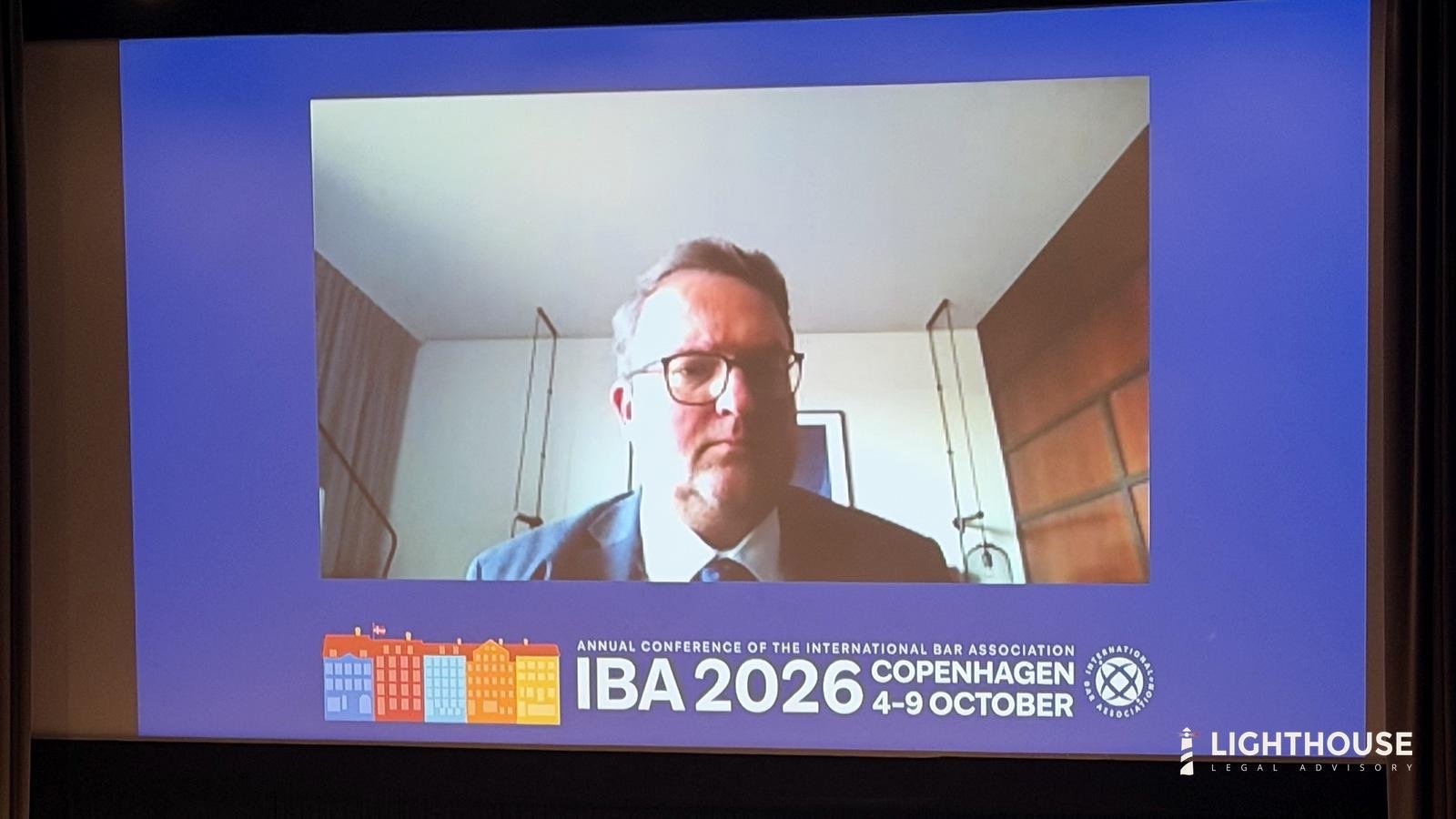
Ambassador Anton Korynevych, Ukraine’s Agent before the International Court of Justice, joined the conversation remotely.
Building the compensation architecture step by step
The session also highlighted that the compensation process is not being built through a single political decision.
Ukraine and its partners have been developing an institutional architecture step by step:
- first, documenting damage;
- then, creating a claims mechanism;
- finally, deciding how compensation will be funded.
Korynevych referred to the Register of Damage and the planned claims commission as parts of this wider framework.
For lawyers and businesses involved in reconstruction, this deserves close attention. The eventual compensation framework may affect not only interstate claims but the wider legal environment around damaged assets, infrastructure, investment losses and reconstruction financing. This is one of the areas where international public law and commercial recovery are likely to intersect more and more.
The Special Tribunal: accountability and deterrence
The conversation then turned to the proposed Special Tribunal for the Crime of Aggression against Ukraine. For the Ukrainian speakers, the project is not only about retrospective accountability. Kostin and Korynevych both connected accountability with prevention.
Their underlying proposition: a legal system that condemns aggression but offers no effective way of holding decision-makers to account risks weakening its own deterrent effect.
The issue is particularly significant because the crime of aggression concerns the decision to start an unlawful war itself, rather than individual acts committed during hostilities. The legal architecture of such a tribunal therefore raises difficult questions of jurisdiction, immunities and enforcement.
The Copenhagen discussion placed those technical problems in a wider frame: whether international law can remain credible when confronted with a major interstate war in Europe.
Peace and diplomacy — but on what terms?
An audience question raised one of the hardest issues facing Ukraine and its partners: if the conflict continues to impose enormous human costs, should greater emphasis be placed on a diplomatic settlement?
The Ukrainian response clearly distinguished diplomacy from capitulation. The speakers stressed that Ukraine seeks peace and remains open to diplomacy, but argued that negotiations require a counterpart genuinely willing to negotiate, rather than one using talks to consolidate territorial gains or prepare renewed attacks. Lund-Sørensen supported that distinction from the Danish perspective.
The question, as framed in the session, was therefore not “war versus diplomacy” in the abstract. It was whether a settlement can be durable if aggression itself is rewarded. That connects directly with accountability: the law governing peace, reparations and responsibility cannot be separated from the conditions under which peace is achieved.
Ukraine as a contributor to European security
Another important shift concerned Ukraine’s European integration. Kostin stressed that Ukraine should not be viewed only as a recipient of European assistance. Ukraine increasingly positions itself as a contributor to European security, bringing operational knowledge, military capability, technological innovation and experience of functioning under extreme conditions.
Lund-Sørensen went further, arguing that it is increasingly difficult to imagine a future European security architecture in which Ukraine is not deeply integrated.
This matters for business too. European integration is not only a political project. It will shape capital flows, procurement, regulatory alignment, defence cooperation, infrastructure and market access — with consequences well beyond traditional reconstruction.
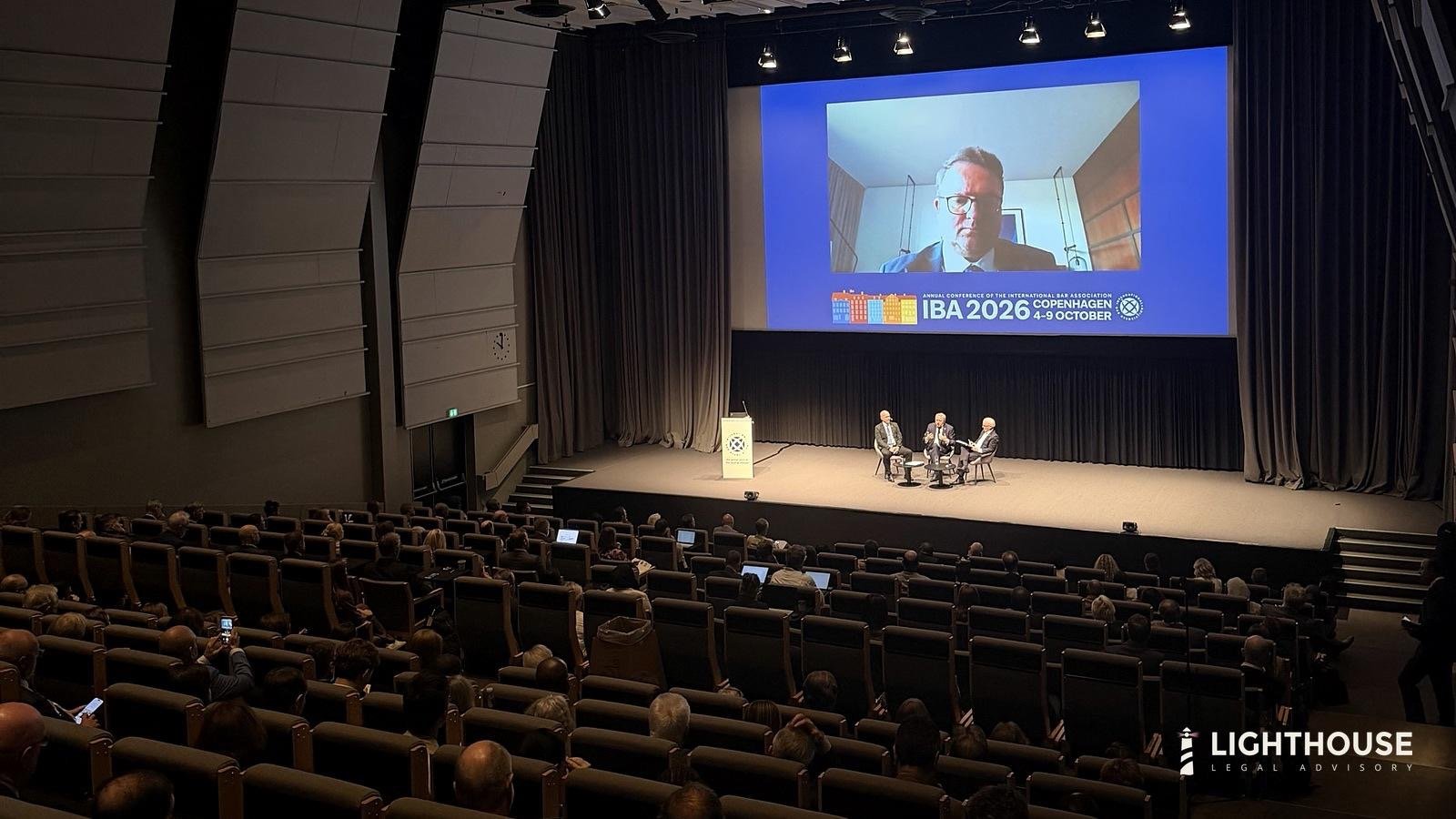
A full auditorium for “A conversation on Ukraine” at the IBA Annual Conference Copenhagen 2026.
Danish companies are already looking beyond aid
One of the most commercially relevant exchanges came from an audience question on Ukraine Facility instruments, blended finance, public-private partnerships and the willingness of Danish companies to enter Ukraine.
Lund-Sørensen confirmed strong Danish business interest. He referred to companies exploring opportunities in agriculture, energy and defence, as well as cooperation with Ukrainian businesses and access to expertise and intellectual property developed during the war.
This is an important distinction for the reconstruction market. The next phase of international engagement with Ukraine cannot be built only around donors transferring money to Ukrainian recipients. Increasingly, the model will combine:
- public funding
- private capital
- risk mitigation
- local Ukrainian expertise
- international technology
- structured legal frameworks
That is precisely why mechanisms such as the Ukraine Facility, blended finance and PPP structures are becoming more important. For international businesses, the question is shifting from “Is Ukraine investable?” to “How should the risk be structured so that we can enter?”
The Lighthouse perspective
For Lighthouse Legal Advisory, the Copenhagen conversation shows why Ukraine-related legal work increasingly requires several disciplines to be read together:
- International law determines responsibility, reparations and sanctions.
- European policy determines the scale and durability of support.
- Reconstruction mechanisms determine where capital can flow.
- Ukrainian regulation determines how projects are implemented.
- Private contracts ultimately turn political commitment into operating projects.
Our earlier work on Ukraine’s reconstruction architecture shows the same convergence: foreign participants may meet Ukrainian public procurement rules, donor requirements, investment-pipeline mechanisms and international funding conditions within a single project.
The significance of the IBA discussion is therefore not limited to the war. It is about what comes next. A Ukraine increasingly integrated into Europe will require lawyers, governments, investors and companies to build frameworks that deliver security, accountability, investment and reconstruction at the same time.
And one of the strongest messages from Copenhagen was that Ukraine does not intend to enter that system merely as a beneficiary. It intends to enter it as a partner.
Planning a project in Ukraine?
If your company is assessing reconstruction, investment or partnership opportunities in Ukraine, Lighthouse can help you structure the legal side — from risk allocation to cross-border contracts. Write to us: info@lighthouse-legal.eu
Session: “A conversation on Ukraine with… Andriy Kostin, Anton Korynevych and Thomas Lund-Sørensen”, IBA Annual Conference Copenhagen 2026, 7 October 2026, 13:15–14:15. Moderator: Dr Mark Ellis, Executive Director, International Bar Association. Speakers: Ambassador Anton Korynevych (Ministry of Foreign Affairs of Ukraine); Ambassador Andriy Kostin; Thomas Lund-Sørensen, Ambassador of Denmark to Ukraine. Session page: https://www.ibanet.org/session-details/se_426101