
By Alexander Romanishyn, board member of ISE Group, Former Deputy Minister of Economy of Ukraine
For years, the Ukrainian-American business community has been visible in Washington as a humanitarian story. On April 16, 2026, it arrived on Capitol Hill as an economic argument — with a dataset, a capital model, and a legislative ask. The sequence was deliberate. So was the timing.
Why This Dialogue, Why Now
The timing was strategic. The UA2USA Capitol Hill Business Dialogue was held on April 16, in the middle of the IMF–World Bank Spring Meetings, when Washington becomes the operating center of global finance, development policy, and sovereign risk conversations, and just ahead of the Ukraine Action Summit, when that broader Ukraine agenda shifts into organized advocacy on Capitol Hill. In that narrow window, the dialogue inserted a missing actor into the room: Ukrainian-American business, presented not as a community story or a humanitarian extension, but as a structured economic force with data, operating experience, and a credible role in reconstruction. That is why the sequence mattered — evidence first, then business voices, then capital architecture, then legislation. It matched the moment: global capital was already in Washington, Ukraine was already on the agenda, and the question was no longer whether support exists, but how to connect business, policy, and investment into one actionable framework.
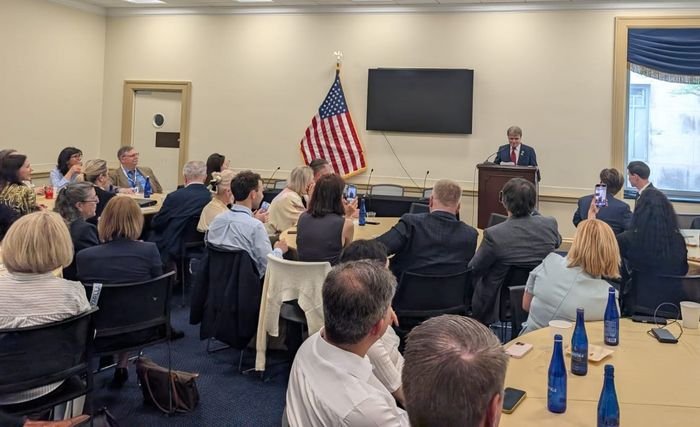
The UA2USA Business Index came first — because data turns community presence into policy relevance. Then came the Ukrainian-American business voices: founders and executives who built real companies inside the U.S. economy, across two very different waves of arrival. Then the capital question: if this community is ready to scale, what is the investment model that connects it to Ukraine’s reconstruction pipeline? And finally, the legislative block — because none of it holds without the policy environment to sustain it.
That structure reflected a judgment about what Congress needed to hear, and in what order.
The Index: Behavior, Not Sentiment
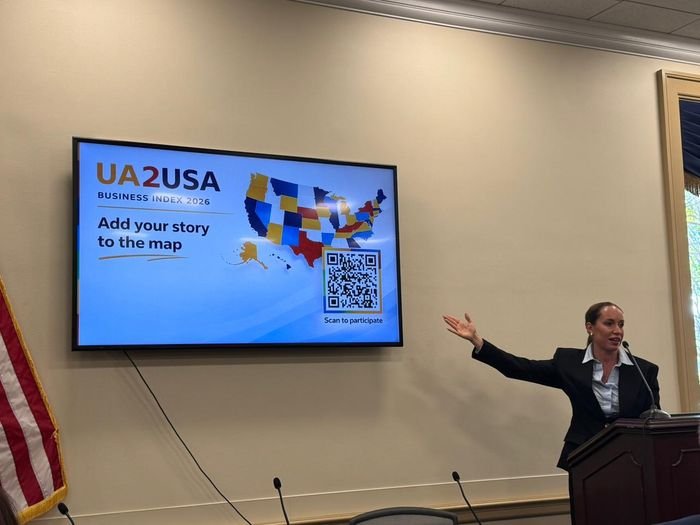
Angela Savenko, Partnerships Expert at ISE Group, presented the second edition of the UA2USA Business Index — the first longitudinal survey of Ukrainian-American businesses in the United States, and the first with year-over-year data substantial enough to show direction of travel.
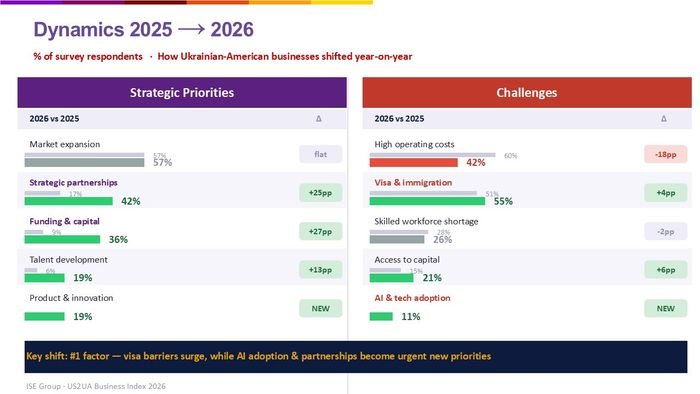
Technology leads at 43.5% of respondents. The behavioral shift between 2025 and 2026 is the signal: strategic partnerships jumped from 17% to 42%. Capital access from 9% to 36%. Talent development from 6% to 19%. In a single year, the Ukrainian-American business community moved from internal consolidation to active outward growth. A category absent from last year’s survey appeared in 2026 — AI and technology adoption, flagged by 11% of firms. These are businesses growing into new complexity, fast.
The challenge side completes the picture. Visa and immigration constraints climbed from 51% to 55% — now the single most cited barrier, ahead of operating costs for the first time. The tension is sharpest in tech: 60% of firms name visa constraints as their primary obstacle while 95% of those same firms plan to hire this year. That gap is precisely what the Index was built to make visible — a policy failure sitting inside a growth story, documented in numbers, presented directly to Congress.
The Index is the argument. Everything else is the context around it.
Add your business: ise-group.org/yourstory
Two Waves, One Community
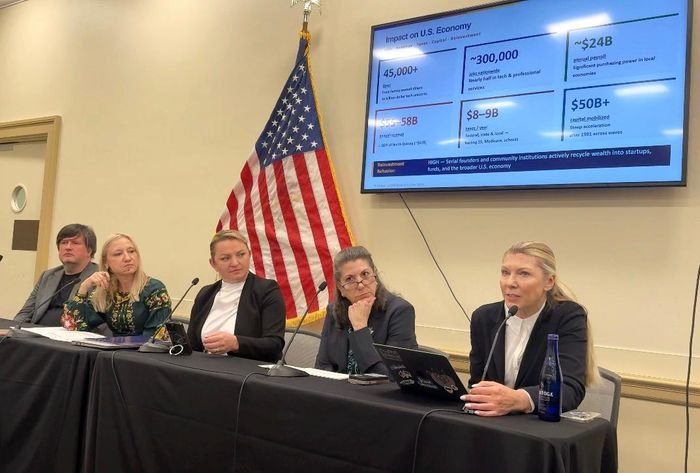
The business panel that followed put faces on the data — and revealed something the Index alone could not show: that “Ukrainian-American business” is at least two waves, with different entry points, different asset bases, and the same underlying argument.
Valerii Iakovenko built DroneUA before the full-scale invasion — a company premised on the idea that autonomous systems would define modern warfare and industrial logistics. By the time the war made that obvious to the rest of the world, DroneUA was already operational. His trajectory represents the first wave: founders who built in Ukraine, relocated with their companies and expertise, and now sit at the intersection of defense technology and reconstruction infrastructure.
Olena Levko-Sendeha, Executive Director of Selfreliance Association, represented something older. Selfreliance Federal Credit Union — founded in 1951, nearly 49,000 members, over $1.1 billion in assets — is 75 years of financial infrastructure built by Ukrainian immigrants long before anyone called them a diaspora or measured their economic footprint. Her presence on the panel connected the post-2022 wave of founders to an institutional tradition that predates this entire conversation by decades.
Two waves. Different timelines. The same compounding logic. Eva Sigaev, President of UACCI, drew the line between them:
“We are builders, not just beneficiaries — American Ukrainians turn displacement into dynamism, adapt rapidly, and create value that strengthens local U.S. economies while keeping one foot firmly planted in Ukraine, and when we close the gaps in coordination, capital access, and policy support, this ecosystem shifts from promising contributor to strategic multiplier for U.S.–Ukraine economic cooperation at true scale.”
Erin E. McKee, CEO of Nova Ukraine and former U.S. Ambassador, named the specific failure the Index is designed to fix:
“The biggest missed opportunity is sharing the data to connect policymakers and businesses to concrete economic opportunities at scale — because this community is already here, already building, and uniquely equipped to bridge both markets in ways no other partner can.”
The Capital Architecture Question
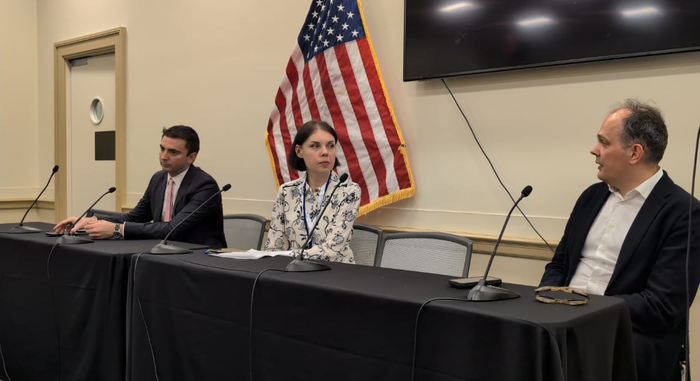
The third block of the dialogue asked the question the first two raised: if the Ukrainian-American business community is ready to scale and Ukraine’s reconstruction pipeline is opening, what is the investment model that connects them?
The fireside chat was moderated by Vitaly Goncharuk, Mentor ISE Group, CEO of 12New.AI and A19Lab, with Marius Dan — Chief Executive Officer for Central Asia at Templeton Global Investments and a senior Franklin Templeton executive involved in both Romania’s Fondul Proprietatea and the Uzbekistan National Investment Fund. The conversation was grounded in precedent, not theory.
Franklin Templeton took over as investment manager of Fondul Proprietatea in 2010; the fund listed in Bucharest in January 2011 and on the London Stock Exchange in April 2015. According to the Financial Times, it returned nearly $7 billion to shareholders and generated returns of over 600% since listing. On the same day as the Capitol Hill dialogue, Reuters reported that Uzbekistan’s National Investment Fund had secured cornerstone agreements for its planned London IPO — including backing from BlackRock — as part of a dual-listing on the London and Tashkent exchanges.
The point was not the numbers. The point was that the model exists, has worked in comparable post-transition contexts, and the institutional appetite is demonstrably there. Marius Dan:
“Through the work of transforming assets and improving governance, the government exits at significantly higher valuations two or three years down the road — and the people, through the fund, are the ones who benefit from that value creation.”
On Ukraine specifically: “Obviously.”
Daryna Marchuk, Deputy Minister of Economy of Ukraine, reinforced that the Ukrainian side has already made its decision on timing:
“Our philosophy is that we do not wait until the war ends — we work with international partners to provide risk insurance mechanisms for those who come and participate in privatization efforts now, because the opportunity is real and the assets are ready.”
The Ukrainian-American business community is the natural connective tissue between that capital architecture and the U.S. market. The networks, the language, the bilateral presence — and now, the Index to prove the scale of intent — are all in place.
The Constraint the Data Makes Visible
The businesses planning to hire and expand — 80 to 95% of surveyed Ukrainian-American firms, across every sector — are operating inside an immigration system that is working against them. Research compiled by Margot Liubchenko from USCIS and DHS data: approximately 200 Ukrainians fall out of legal status every day. Over 155,000 are ineligible for Temporary Protected Status because of an arbitrary arrival cutoff. TPS itself expires October 19, 2026.
This is the contradiction the Index surfaces in numbers: a community growing faster than the policy environment can accommodate, being asked to anchor U.S.–Ukraine economic cooperation while navigating monthly legal uncertainty. The Ukrainian Adjustment Act (H.R. 3104) — 19 bipartisan cosponsors, over 47,000 petition signatures — provides a pathway to permanence. The economic case for passing it is the same as the economic case for the Index: stabilize the foundation the bilateral relationship is being built on.
What Comes Next
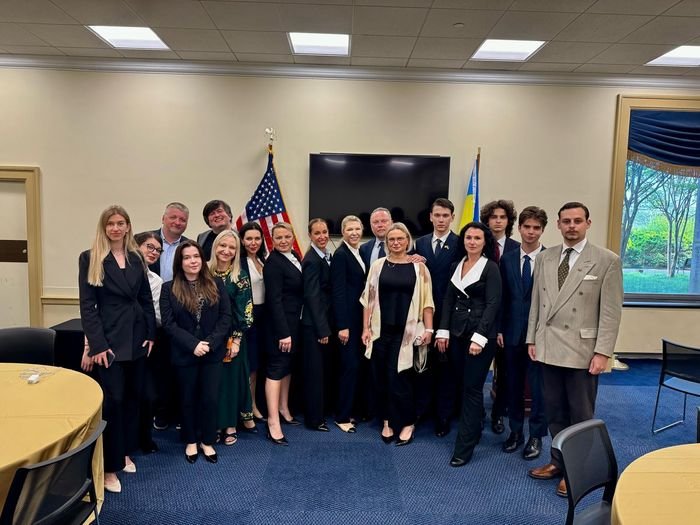
Three things now have the evidence base and the political moment to move: annual institutionalization of the UA2USA Index as a standing policy reference for U.S.–Ukraine economic engagement; a formal capital architecture linking the Ukrainian-American business ecosystem to Ukraine’s privatization pipeline; and passage of the Ukrainian Adjustment Act to secure the human capital the entire structure depends on.
The Index is the beginning of a different kind of conversation — one where the Ukrainian-American business community speaks in evidence, earns its seat at the table on the strength of its contribution, and builds the capital architecture that connects two economies with a shared future.
Full UA2USA Business Impact Study: ise-group.org/impact-study
UA2USA Capitol Hill Business Dialogue — April 16, 2026, Washington D.C.
Acknowledgments: Selfreliance Association and Selfreliance Federal Credit Union. Nova Ukraine — Erin E. McKee, Sashko Krapivkin. Svitanok — Oleksandr Taran. ISE Group — Olena Malytska, Vitaly Goncharuk. Kateryna Kovalenko. ONE Campaign — Elizabeth Hoffman. UACCI — Angela Savenko, Olha Lykova. Daniel Runde, Romina Bandura — CSIS. Office of Congressman Mike Quigley — Michael Corcoran. Ihor Baranetskyi, Embassy of Ukraine in the USA. Margot Liubchenko for USCIS/DHS research.
The core content team of the UA2USA Capitol Hill Business Dialogue: Eva Sigaev, Vitaly Goncharuk, Alexander Romanishyn