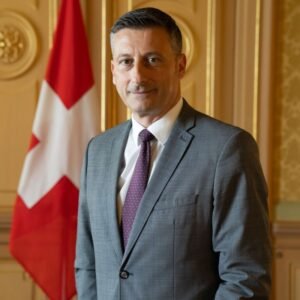
By Jacques Gerber, Federal Council Delegate for Ukraine1
A war of attrition, a resilient population
After nearly four years of war, Ukrainian cities continue to be under large attacks by Russian missiles and drone strikes. These are aimed not only at military infrastructure but also, increasingly, at energy infrastructure. The winter of 2025/26 may become particularly difficult: nearly half of the country’s electricity production capacity has been damaged or destroyed.
Despite these difficult circumstances, the Ukrainian people are showing remarkable resilience. In a country where more than six million people have fled abroad and nearly four million are displaced within the country, the will to rebuild and defend democratic values remains intact.
Switzerland’s commitment: solidarity and a long-term vision
True to its humanitarian tradition and international responsibility, Switzerland condemned the violation of international law in 2022 and provided immediate humanitarian support to the Ukrainian people. This support was subsequently expanded on a broad scale.
Accordingly, in the Swiss Foreign Policy Strategy the support of Ukraine was defined as of strategic importance. To that end, the Federal Council foresees CHF 5 billion to support Ukraine and its reconstruction until 2036, marking one of the most significant commitments ever made by Switzerland to a partner country. The first phase, covering the period 2025–2028, was approved by the Swiss Parliament in December 2024: it allocates CHF 1.5 billion, of which CHF 500 million is specifically earmarked for the support by the Swiss private sector. This funding forms the core of the Programme Ukraine 2025–2028, adopted on 12 February 2025.
The programme focusses on three areas of support:
- Protection of the civilian population and peace,
- Economic recovery,
- Strengthening essential public services, particularly in the areas of energy, health, water and education.
To ensure the implementation of the new programme, the Federal Council appointed a delegate to guide, coordinate and, above all, decide on the actions of the implementing offices: the State Secretariat for Economic Affairs (SECO), the Swiss Agency for Development and Cooperation (SDC) and the Peace and Human Rights Division (DPDH).
Building on long-standing cooperation
Two thirds of the programme’s funds comprise humanitarian aid, development and economic cooperation as well was measures promoting peace and justice. The activities in these domains have been built during the last decades of Switzerland’s engagement in Ukraine and can rely on strong ties.
For the protection of the civilian population, Switzerland’s activities focus on emergency relief, humanitarian mine action, strengthening transitional justice measures and fostering dialogue. The aim is to strengthen Ukraine’s resilience to cope with the societal consequences of the war.
Within the domain of economic recovery, Switzerland provides support to Ukraine in economic stabilisation and reconstruction, aligned with local needs. Its priorities are to grow the local private sector and to rehabilitate destroyed infrastructure in order to bolster a resilient economy.
In the domain of strengthening public services, Switzerland targets the sectors of healthcare, education, energy supply and waste/water treatment. The focus lies on capacity-building for the local authorities with the aim of promoting democratic participation and the rule of law.
A new pillar: partnership with the Swiss private sector
One of the new aspects of the 2025–2028 programme is the systematic involvement of the Swiss private sector. This pillar aims to mobilise the expertise, innovation and quality of Swiss companies to support the sustainable and responsible reconstruction of Ukraine.
Until now, the legal basis for international cooperation (the Federal Act on International Development Cooperation and Humanitarian Aid) only allows support for Swiss companies already established in Ukraine. However, the country’s recovery requires attracting new economic players capable of investing, creating jobs and transferring technology.
To fill this gap, Switzerland and Ukraine signed a bilateral agreement on cooperation in the reconstruction process in Rome on 10 July 2025. This agreement, signed at the Ukraine Recovery Conference, establishes the legal basis for Switzerland to also support projects of Swiss companies that are not yet established in Ukraine. The treaty ratification process is currently underway. It is expected to come into force in September 2026.
A bilateral agreement on cooperation in the reconstruction process
The agreement defines the terms of cooperation, the obligations of both parties, the project selection mechanisms, and the environmental, social and governance conditions to be met. Ukraine remains responsible for identifying its needs and implementing projects, while Switzerland ensures transparency and monitoring through SECO.
In accordance with the commitments made to the Swiss Parliament and its foreign affairs committees, the treaty guarantees:
- respect for human rights and ILO core labour standards;
- environmental protection and the principle of ‘green reconstruction’;
- the fight against corruption;
- and good governance in the implementation of projects.
In addition, the treaty provides for a rigorous selection mechanism, reserved for Swiss companies, in accordance with Swiss public procurement legislation, and establishes a joint commission responsible for monitoring, transparency and compliance for each project.
This new instrument will pave the way for structured cooperation in priority areas such as:
- energy reconstruction (electricity grids, renewable energies, and district heating infrastructure),
- transport and mobility,
- construction and water,
- emergency preparedness and civil security.
Call for Proposals for companies already active in Ukraine
Currently, Switzerland can support Swiss companies that already have registered an entity in Ukraine and answer to a Ukrainian need. To that end, the SECO and the Ukrainian Ministry of Economy jointly launched a Call for Proposals at the beginning of 2025.
The Call for Proposals met with great interest, with around 60 Swiss companies submitting almost 80 project proposals. Switzerland and Ukraine assessed the submitted projects according to criteria such as relevance for Ukraine, added value compared to undertakings by others, contribution to Ukraine’s economic development, sustainability and the company’s implementation capacity.
Based on this, twelve companies with the highest-rated projects, with a total budget of over CHF 112 million, were selected to receive a financial subsidy of CHF 93 million through the Ukraine Country Programme, with the remainder coming from the companies and Ukrainian partners. The twelve projects receiving funding are in the areas of infrastructure (energy, housing), public transport, health and humanitarian demining and are scheduled to begin in autumn 2025. Given the high interest among the Swiss private sector, a second Call for Proposals is being considered in the near future.
Jointly working towards “building Ukraine back better“
The war in Ukraine is a tragedy with devastating consequences for millions of people. At the same time, however, it has also revealed the remarkable resilience of the Ukrainian population and the solidarity of the international community united around the principles of international law.
By supporting Ukraine’s reconstruction with its broad set of tools, Switzerland is making a meaningful contribution to Ukraine, a country at war that continues to stand up for sovereignty and independence. The reconstruction of Ukraine offers an opportunity to build back better for a more sustainable and inclusive future for the Ukrainian people. Switzerland actively contributes to that goal.