



After exploring biosolar roofs in Switzerland, the conversation naturally moved to a key question:
What happens when solar is not enough?

In reconstruction contexts – especially in Ukraine – relying on a single energy source is not just inefficient, but risky.
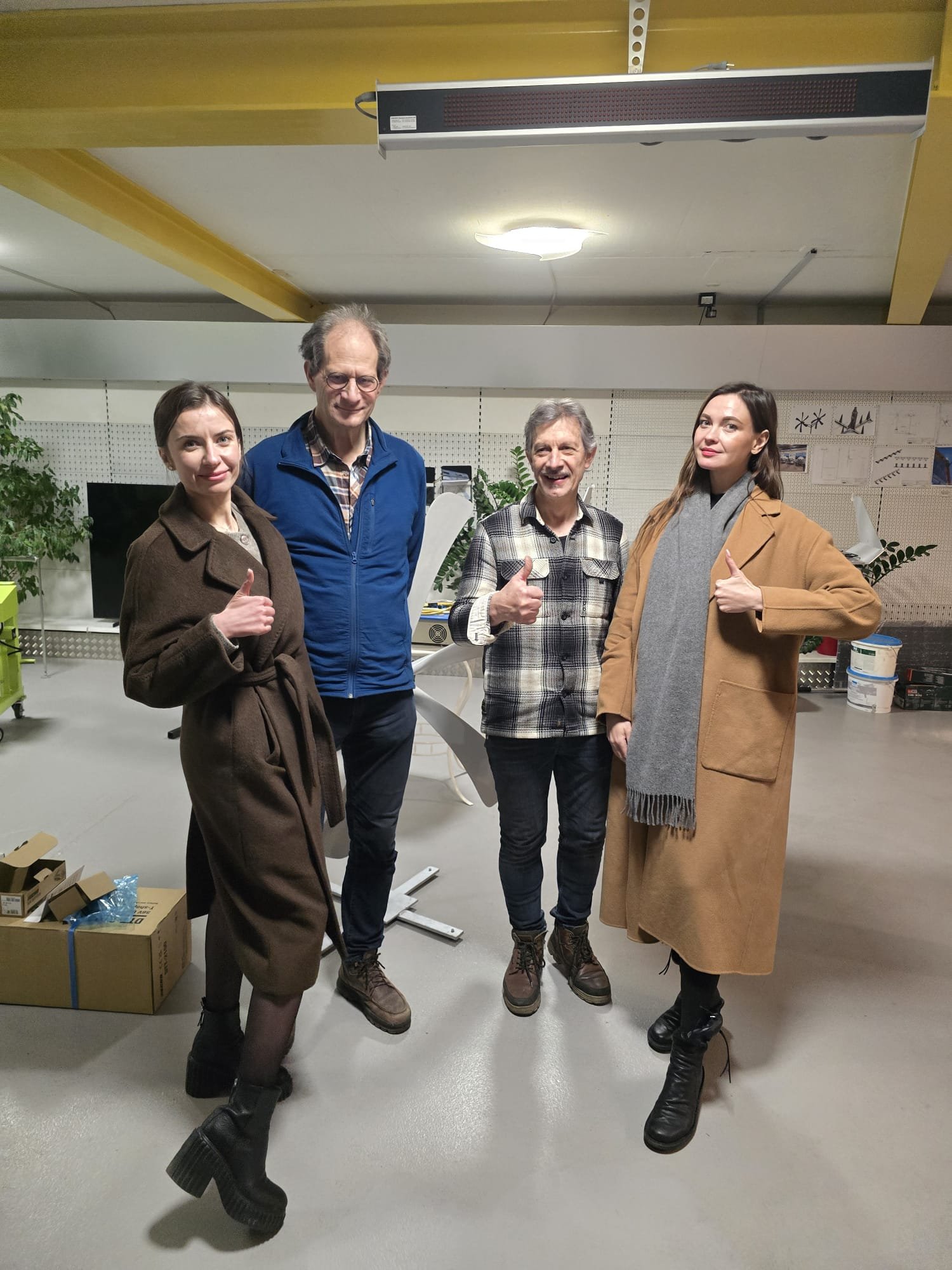
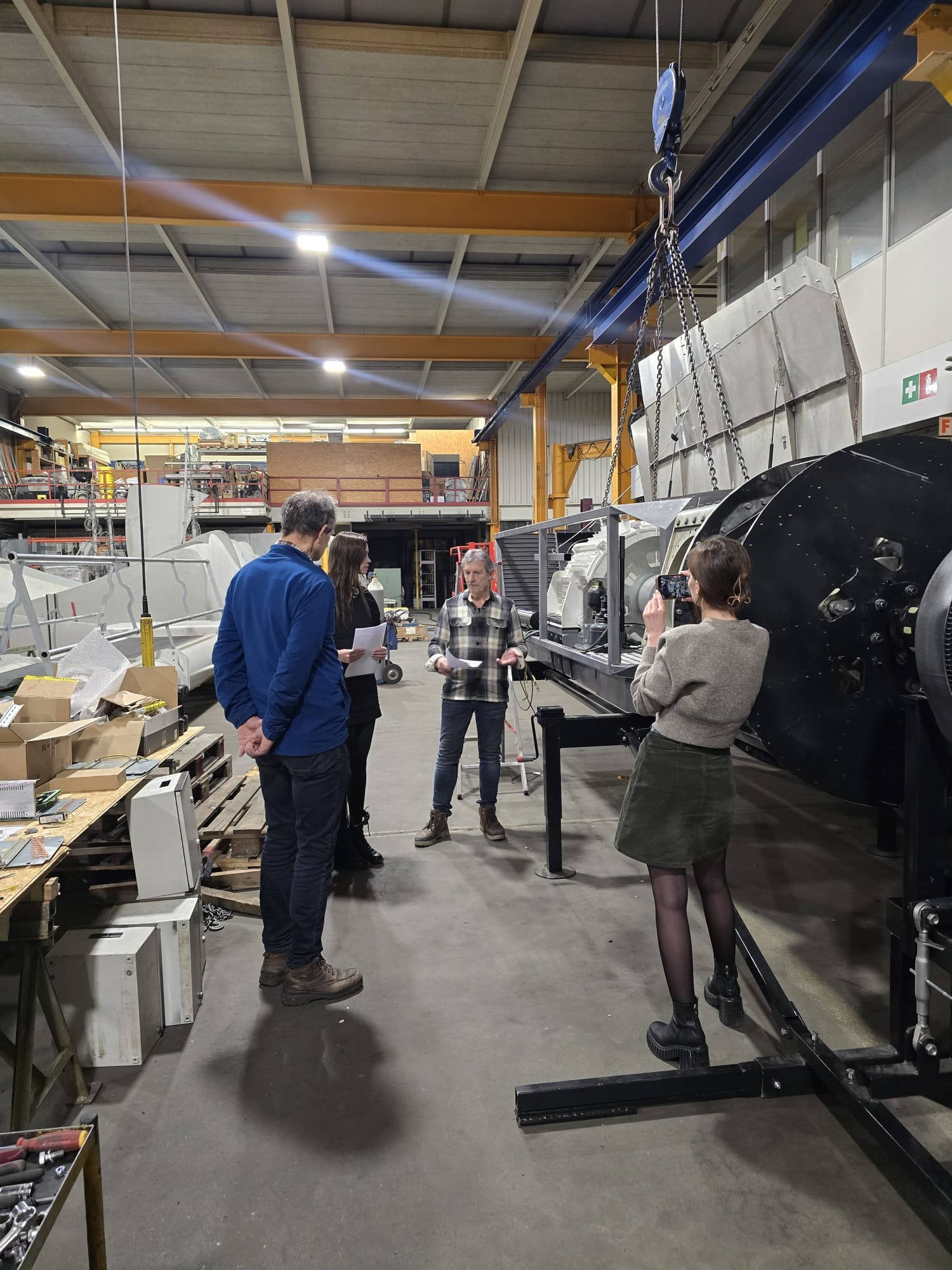
That is where the Lighthouse team, together with Andreas, visited a production site in Switzerland to explore a complementary technology: decentralised wind energy systems developed by WepfAir.
As Andreas puts it during the visit:
“There is no single solution. Solar, biomass, wind – they must be combined and applied in the right place.”
Technological Approach: Decentralised Wind Systems
In contrast to conventional large-scale wind turbines, the systems developed by Wepfair reflect a decentralised design approach. These solutions are characterised by smaller, modular configurations, intended for distributed deployment and capable of operating under variable and irregular wind conditions. Their design also allows for installation with reduced infrastructure requirements compared to traditional wind energy installations.
As noted during the interview, the development objective was not to replicate existing turbine models, but to address structural limitations associated with large-scale wind systems – including noise levels, environmental impact, and installation complexity.
From a technical perspective, the systems incorporate several distinguishing features. These include lower rotational speeds, which contribute to reduced impact on birds and wildlife, as well as the ability to maintain performance under unstable wind conditions. Additional characteristics include an emphasis on durability and extended operational lifespan, the possibility of installation without conventional foundation structures, and design solutions that facilitate transport and enable relatively rapid deployment.
As explained by the founder during the interview :
The goal was not to build “another wind turbine”, but to eliminate key disadvantages of large turbines – including noise, ecological impact, and installation complexity.
Key technical features
- Low rotational speed → reduced impact on birds and wildlife
- High efficiency even in unstable wind conditions
- Long lifecycle (design focus on durability)
- Potential installation without traditional foundations
- Compact transport and rapid deployment
Why This Matters for Ukraine
The applicability of decentralised wind solutions to Ukraine’s reconstruction context is primarily linked to the need for resilience-oriented energy systems. Beyond increasing generation capacity, the current conditions require infrastructure that can operate under disruption, be rapidly deployed, and, where necessary, be relocated or replaced with minimal delay.
In this context, decentralised wind technologies acquire strategic relevance. Their design characteristics allow for deployment in a range of scenarios, including support for hospitals and other critical infrastructure, use in remote or partially damaged regions, and integration within agricultural and industrial facilities.
A key advantage lies in their compatibility with hybrid energy configurations. In combination with solar generation, wind systems can contribute to a more balanced and continuous energy supply, reflecting complementary production patterns across seasons and time of day. Such hybridisation enhances overall system reliability and reduces dependence on single-source generation.
Use cases discussed during the visit
- Hospitals and critical infrastructure
- Remote or partially destroyed regions
- Agricultural facilities
- Industrial zones
- Hybrid systems with solar (day/night balancing)
Wind complements solar particularly well:
- 🌞 Solar → peak in summer / daytime
- 🌬 Wind → stronger in winter / nighttime
Together, they create continuous generation capacity.
From Megawatts to Microgrids
A central insight emerging from the analysis is the increasing relevance of smaller-scale, locally deployed energy systems alongside traditional large-capacity installations. This reflects a broader shift away from exclusively centralised generation models toward distributed energy architectures.
Within this approach, emphasis is placed on micro-generation, on-site energy consumption, and reduced dependency on central grid infrastructure. Such configurations are consistent with wider European and global trends, including the development of decentralised energy systems, energy communities, and resilience-oriented infrastructure planning.
From an operational perspective, this model may offer additional advantages, including lower transport and installation complexity, reduced capital intensity, and decreased exposure to single-point failures within the energy system.
Engineering Meets Reality
During the site visit, the observed technology portfolio covered multiple system scales, including small rooftop turbines (approximately 1.5–4 m in diameter), medium-capacity units suitable for agricultural and industrial use, and modular configurations reaching up to approximately 240 kW.
Across these configurations, a consistent design approach was evident: prioritisation of deployability, maintainability, and operational flexibility. This reflects a shift away from capital-intensive, infrastructure-heavy models toward solutions that can be implemented in constrained or rapidly changing environments.
In practical terms, this approach is characterised by simplified mounting systems, reduced reliance on permanent or heavy foundations, and the use of modular electronic and mechanical components. Such design choices are directly relevant for jurisdictions or contexts where speed of deployment, ease of replacement, and logistical efficiency are critical factors in project implementation.
The Policy Layer: Why It’s Not Just Technology
As Andreas highlights, energy transition is not purely technical:
“Top-down is not enough. It must also work bottom-up — society must accept and integrate the technology.”
The deployment of decentralised energy solutions introduces a set of regulatory and policy considerations that extend beyond purely technical implementation. These include, in particular, permitting and certification requirements, environmental compliance obligations, grid integration rules, and factors related to public acceptance.
In the Ukrainian context, these considerations acquire additional significance. Reconstruction efforts are increasingly expected to align with EU regulatory standards and energy policy frameworks. At the same time, projects financed through international donors or financial institutions are subject to layered compliance requirements, including procurement, reporting, and audit obligations.
Within this framework, decentralised energy systems may offer a practical advantage, as they can, in certain cases, reduce dependency on large-scale infrastructure and mitigate regulatory and logistical bottlenecks associated with centralised energy projects.
Strategic Takeaway for Reconstruction
The combined analysis of biosolar roof systems (Case 1) and decentralised wind solutions (Case 2) points to a broader model of reconstruction based on hybrid, modular, and locally deployable energy systems.
Within this model, reconstruction is not limited to restoring pre-existing infrastructure. Rather, it enables a transition towards distributed energy architectures that enhance system resilience, reduce exposure to single-point failures, and allow for the integration of multiple renewable energy sources.
Such an approach is consistent with emerging European energy policy trends and offers a structurally more robust framework for rebuilding energy systems in conditions of uncertainty and disruption.
As Andreas summarises:
“Solutions must not stay in Switzerland — they must be implemented where they are needed.”
What This Means for Stakeholders
The adoption of hybrid and decentralised energy solutions carries distinct implications for different stakeholder groups involved in Ukraine’s reconstruction.

For donors and international financial institutions (IFIs), such systems offer scalable, pilot-ready solutions with clearly measurable outcomes, including improved energy access and enhanced resilience. They also align with climate policy objectives and broader decarbonisation commitments.
For Ukrainian public authorities, decentralised energy systems provide flexibility in deployment, particularly in damaged or hard-to-reach regions, and may reduce reliance on large-scale grid restoration. At the same time, they can be structured in a manner compatible with international funding frameworks and associated compliance requirements.
For the private sector, these solutions create entry points into the reconstruction process through modular and replicable business models. They also enable the transfer and localisation of technology and expertise, as well as the development of partnerships with Ukrainian implementing entities.
Lighthouse Insight
This case highlights a key shift:
Reconstruction is no longer about replacing infrastructure – it is about redesigning systems.
Decentralised wind, combined with solar and other renewables, is not a niche solution – it is a strategic layer of resilience.
And most importantly:
“It works not only in theory – but already in practice.”
If you are working on Switzerland-Ukraine cooperation, structuring reconstruction projects, or navigating legal and governance risks in cross-border environments, I would be glad to connect and exchange insights.
info@lighthouse-legal.eu
